Joe Bell
Breakfast at Tiffany'sJoe Bell is the proprietor of a Lexington Avenue bar and one of the few people whose long attachment to Holly Golightly survives her absence and disgrace. He keeps watch for her in the city, mobilizes help when she is arrested, and finally hires a limousine to take her to the airport. His loyalty is neither serene nor unconditional: he can condemn Holly’s choices, yet repeatedly acts to protect her.
Identity and the neighborhood bar
Joe Bell runs a quiet bar around the corner from the brownstone where Holly Golightly and the Unnamed Narrator once lived. During the war, both tenants regularly came in six or seven times a day to use the telephone, a private line then difficult to obtain. Joe also took Holly’s many messages, making the bar a practical extension of her unsettled life as well as a place where she and the Unnamed Narrator could reach the outside world.
The bar’s modest atmosphere reflects its proprietor. It has no neon sign or television; two old mirrors catch the changing weather outside, and a bowl of fresh flowers stands behind the counter among photographs of ice-hockey players. Joe arranges the flowers himself with painstaking care. The room is at once a neighborhood business and a personal interior, shaped by the interests and habits that make its owner difficult to approach.
Joe admits to having a sour stomach and a difficult nature. His enthusiasms include ice hockey, Weimaraner dogs, the radio serial Our Gal Sunday, and Gilbert and Sullivan; he claims a family connection to one of the latter pair. The Unnamed Narrator says that Joe is hard to talk to unless the other person shares one of his fixations. Holly is the most consequential of those fixations, although Joe and the narrator are not close friends in their own right: their bond is chiefly their shared friendship with her.
Watching for Holly
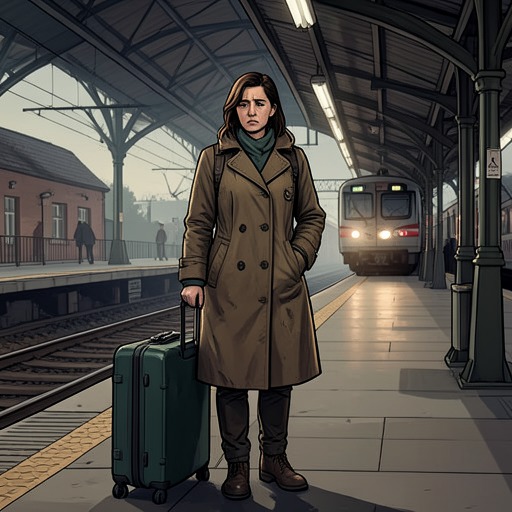
After Holly disappears from the neighborhood, Joe’s concern takes the form of a long, solitary vigil. He says he has walked the city streets for ten or twelve years with his eye out for her, and that no one he sees proves to be the person he is seeking. Instead, he recognizes fragments: a slim girl walking quickly and straight, or a particular shape glimpsed in passing. His search has lasted long enough to become part of how he moves through the city.
When he explains why he thinks Holly is not living in New York City, his reasoning is personal rather than evidentiary: if she were there, he believes he would have seen her. The Unnamed Narrator is startled to realize the depth of Joe’s feeling and tells him he had not known Joe was in love with her in that way. Joe is disconcerted, gathers up the photographs he has been showing, and puts them back in their envelope. The exchange exposes an intimacy that Joe does not comfortably name; his devotion is visible in the years of looking, while direct recognition of it makes him retreat.
Loyalty tested by crisis
When Holly returns and explains that she never divorced Doc Golightly because she was only fourteen when they married, Joe is present at the bar while she orders more drinks before noon. He complains that she is rocking the boat early and has already served three rounds. Holly answers that it is Sunday, says the clocks run slowly on Sundays, and explains that she has not yet been to bed. Her visit brings Joe into the aftermath of her reunion with Doc, but the available scene shows his practical response to the drinking more clearly than any judgment about the marriage.
Joe’s loyalty becomes more urgent after Holly’s arrest in the Sally Tomato case. Hearing that she could face ten years or more, he snatches the papers away and proposes phoning her wealthy acquaintances for better lawyers than he can afford. The Unnamed Narrator is too shaken to dress without help; Joe assists him, then sets him up in the telephone booth at the bar with a triple martini and a brandy glass full of coins. The search for assistance falters: O. J. Berman cannot be reached, and Mag Wildwood rejects any association with Holly. Joe’s attempts show both the limits of Holly’s social circle and his willingness to make the calls that others evade.
His anger is sharp because his concern is not abstract. Joe rebukes the Unnamed Narrator for taking the news calmly and calls him a bastard for having meant to be Holly’s friend. When the narrator clarifies that Holly carried messages without knowingly participating in the crime, Joe still insists on the danger she faces. His response combines accusation with immediate care: he scolds the people closest to her while trying to assemble legal help for her.
The airport departure
At the bar before Holly leaves, Joe will not join her in a farewell toast. He tells her that if she is going to hell, she will go on her own, with no further help from him. The refusal sounds final, but his actions contradict it. A limousine pulls up outside, and the Unnamed Narrator briefly suspects that Joe has called the police. Joe blushes, then reveals that he hired the car to take Holly to the airport.
Joe turns away to fuss with the flowers. When Holly asks him to look at her, he refuses, pulls flowers from the vase, and thrusts them toward her; they miss and scatter across the floor. He says goodbye and hurries into the men’s room, where he locks the door. The scene brings his conflicting impulses into a single gesture: he cannot endorse Holly’s flight, but he has arranged the means for it; unable to face the departure, he leaves the flowers—the recurring sign of his careful attention—spilled between them.
Narrative role
Joe gives the story a fixed point from which Holly’s mobility can be measured. His bar supplies telephones and takes messages, while his years of walking in search of her register the cost of her disappearance in someone else’s life. He does not control Holly’s choices or secure her safety, and his help cannot erase the estrangement of her departure. Instead, his character is defined by the gap between what he says and what he does: he rebukes her, refuses to toast her, and still hires the car that carries her away. The flowers he arranges with such care become an apt counterpoint to that rough, reluctant tenderness.